Mobility systems are inherently multi-scale, but do mobility networks exhibit self-similarity across scales? We introduce the Neighbor-Limited Box Covering method to explore self-similar structure and multi-scale spatial organization in mobility networks.
01 / Introduction
Mobility, encompassing the movement of both humans and goods, is an essential component of daily life. Mobility systems are inherently multi-scale, linking nearby places, cities, regions, and broader socioeconomic systems. Yet whether mobility networks exhibit self-similarity across scales remains largely unexplored.
Although renormalization theory provides a natural framework for investigating self-similarity, existing network renormalization methods often fail to preserve the empirical structure of real-world mobility systems.
| Category | Handles Weighted Networks | Preserves Empirical Connectivity | Preserves Flow Weights |
|---|---|---|---|
| Box-covering renormalization | × | ✓ | × |
| Degree-thresholding renormalization | × | × | × |
| Geometric renormalization | ✓ | × | ✓ |
Core gap: A renormalization framework that preserves both connectivity and edge-weight properties of real-world mobility networks is still lacking.
02 / New method
To address this gap, we introduce the NLBC method for renormalizing undirected, weighted networks. The method iteratively selects box centers in descending order of node strength, groups each center with a fixed number of its highest-weight neighbors into a box, and aggregates edge weights between boxes to construct the network at the next scale.
Here, the maximum number of nodes permitted within a box is defined as the box mass, m. Successive renormalized networks are indexed by the renormalization layer, l.
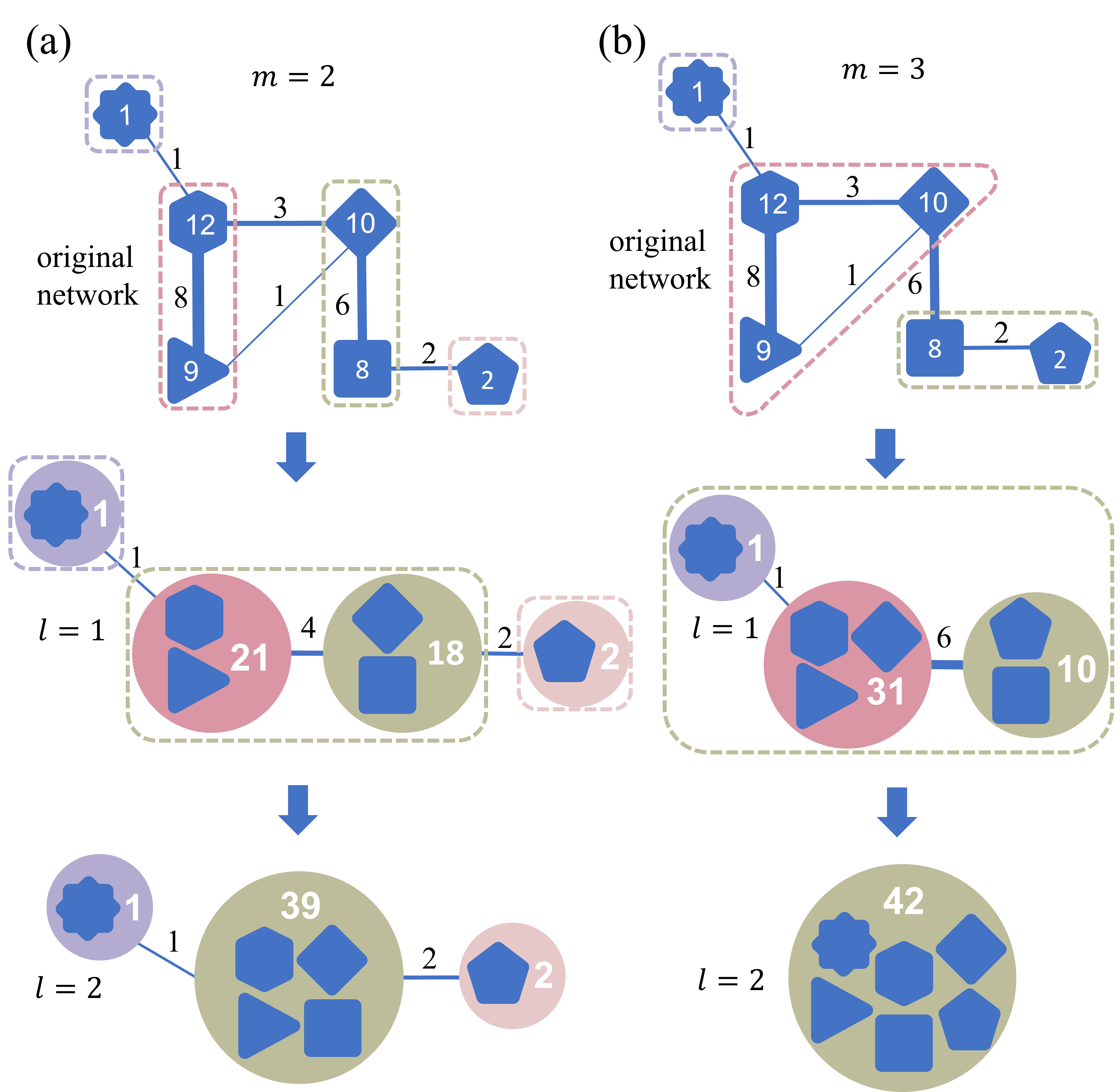
Fig. 1a,b. Schematic illustration of the NLBC renormalization process for (a) m=2 and (b) m=3.
Layer-by-layer (LL-Renorm): Repeatedly apply NLBC with a fixed box mass (e.g., m=2) to generate increasingly coarse renormalized networks.
Single-layer (SL-Renorm): Apply NLBC to the original network once for each box mass (m = 2, 3, 4, . . .) to generate increasingly coarse renormalized networks.
03 / Data
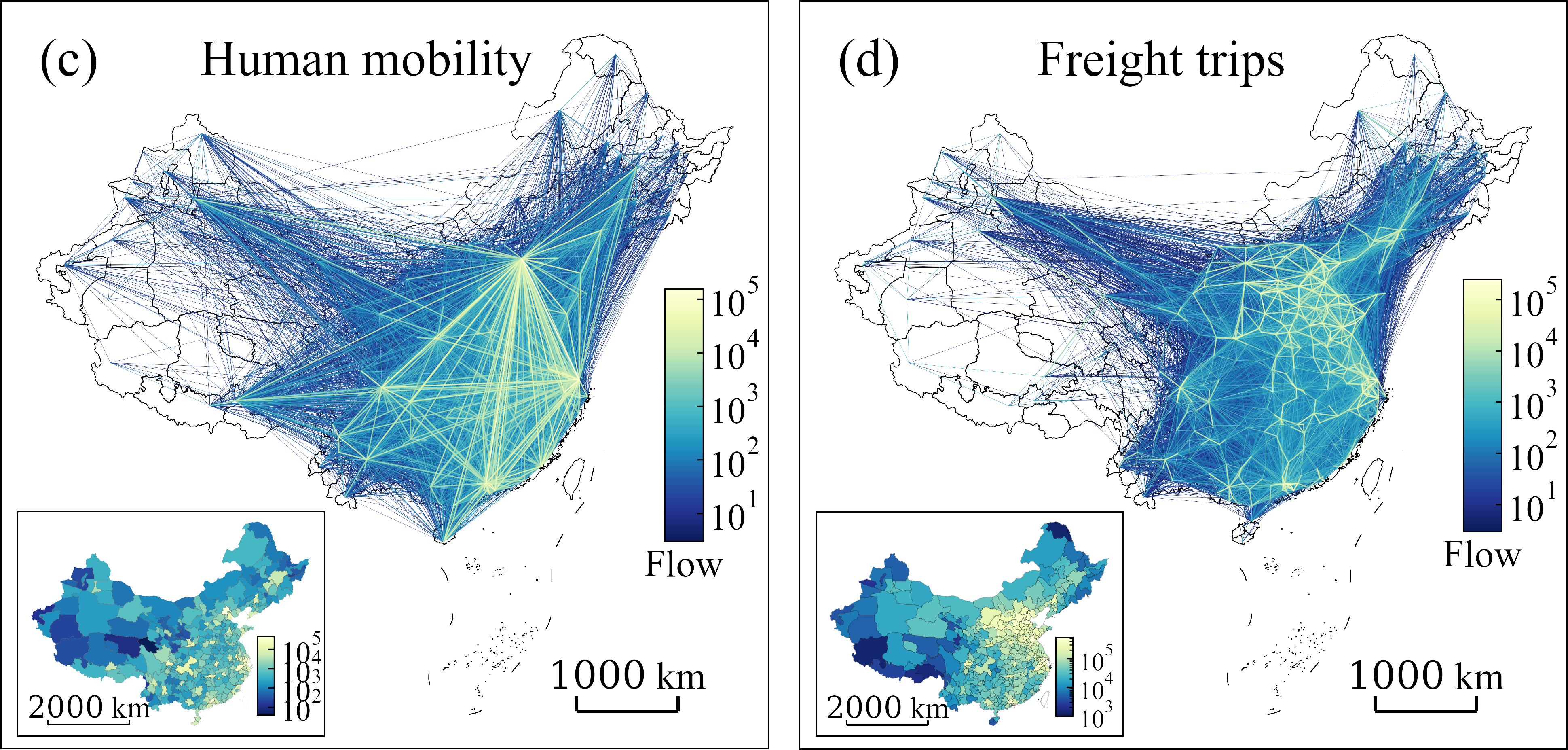
Human mobility: the Sina Weibo check-in records.
Freight trips: the GPS trajectory data from the China Road Freight Supervision and Service Platform.
We apply both LL-Renorm and SL-Renorm to these two mobility networks to uncover their multi-scale structures.
Fig. 1c,d. (c) The inter-city human mobility network and (d) the inter-city freight trip network in China. Cities are nodes, and inter-city movements are undirected, weighted edges.
04 / Result A
We evaluate the self-similarity of multi-scale mobility networks in terms of topological structure, weighted structure, and dynamic processes.
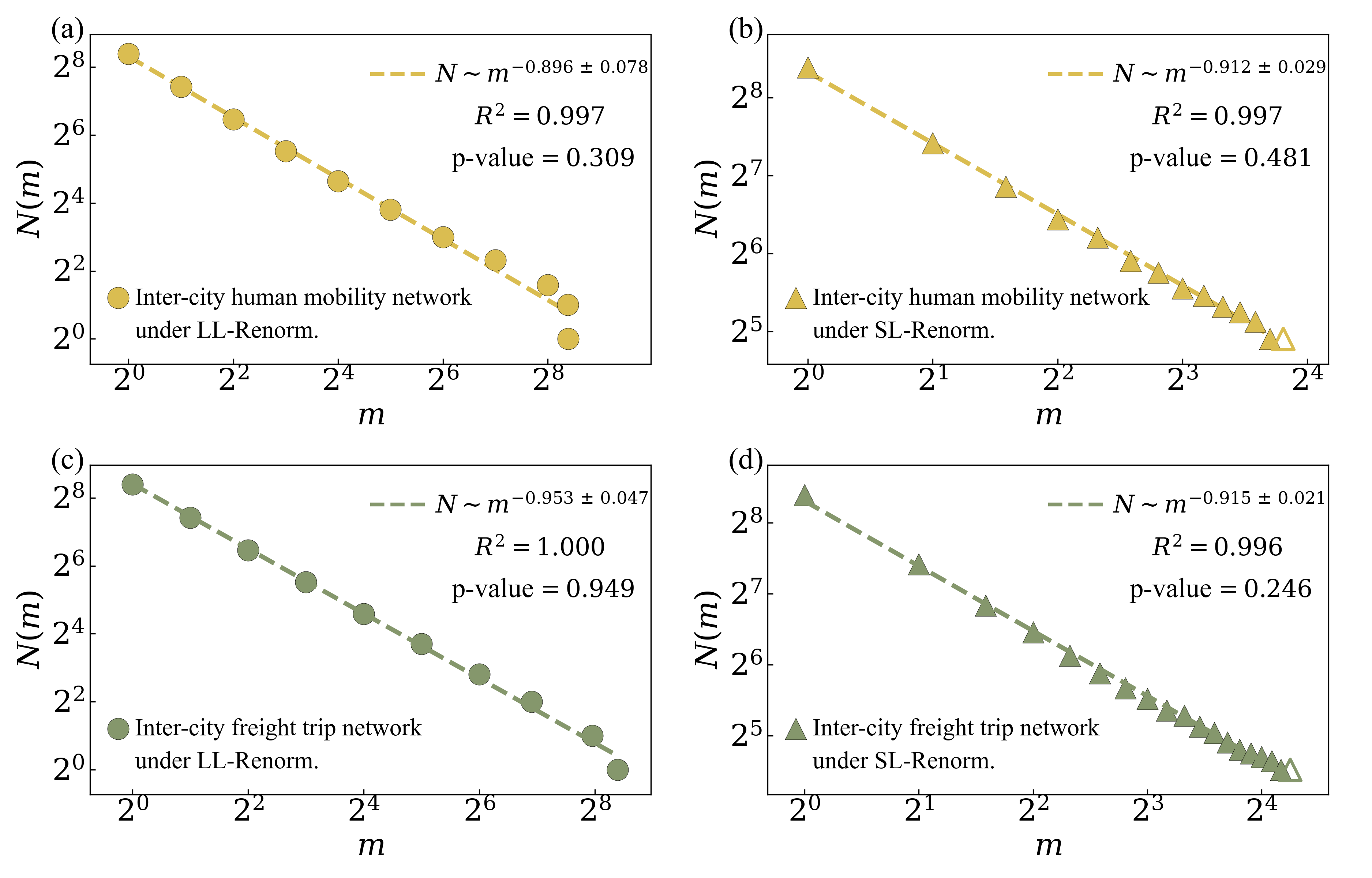
Topological similarity We calculate the fractal dimension df to quantify topological similarity in multi-scale mobility networks. The log-log plots of box number N(m) versus box mass m show clear power-law scaling, indicating self-similar topological structure across scales.
Fig. 2. Self-similar scaling of human mobility and freight trip networks under LL-Renorm and SL-Renorm.
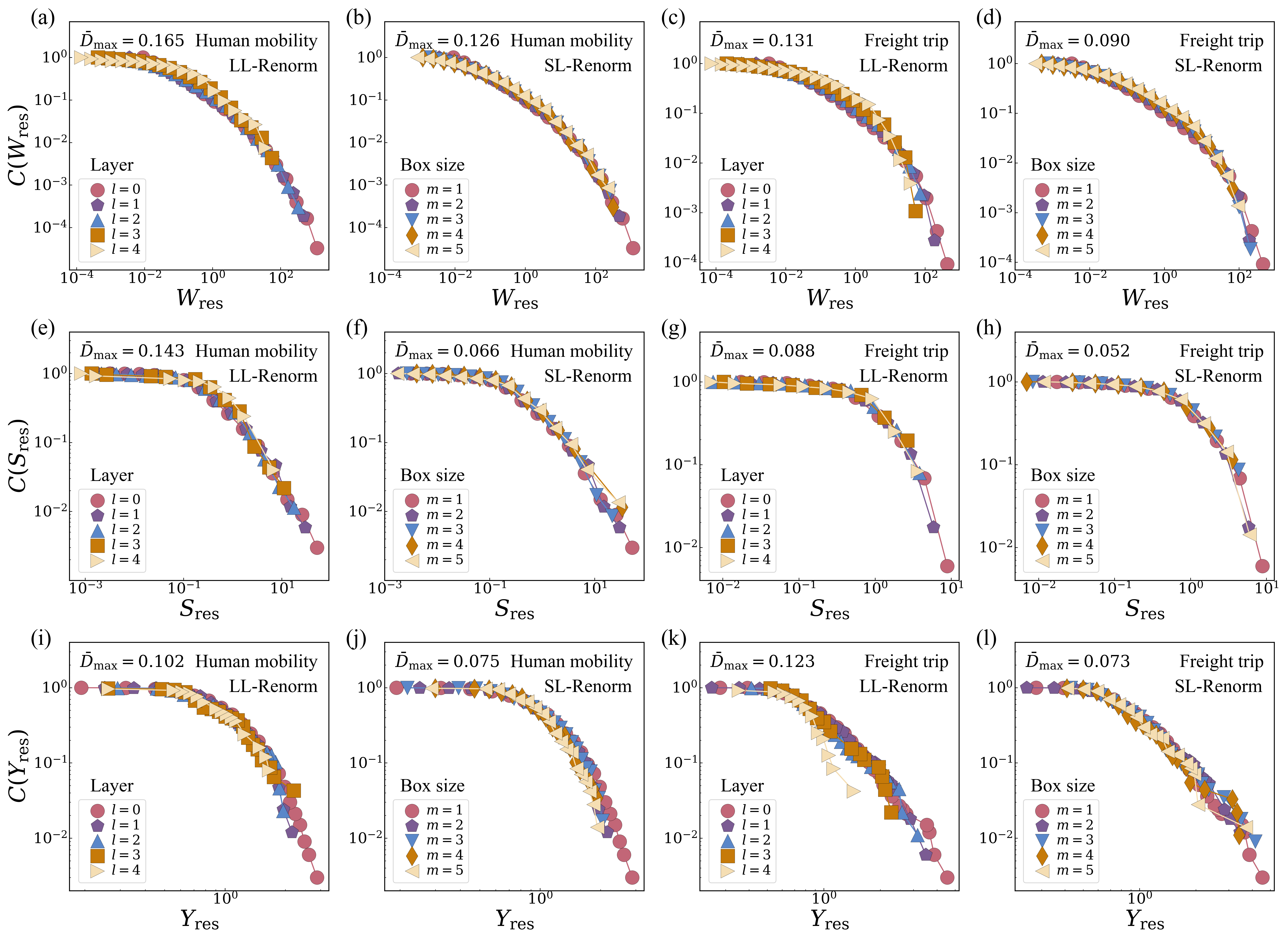
Weighted structural similarity We calculate edge weight wij, node strength Si, and node disparity Yi for multi-scale mobility networks. Their rescaled complementary cumulative distribution functions merge onto nearly identical curves, indicating self-similar weighted structure across scales.
Fig. 3. The weighted structural features for the multi-scale mobility networks.
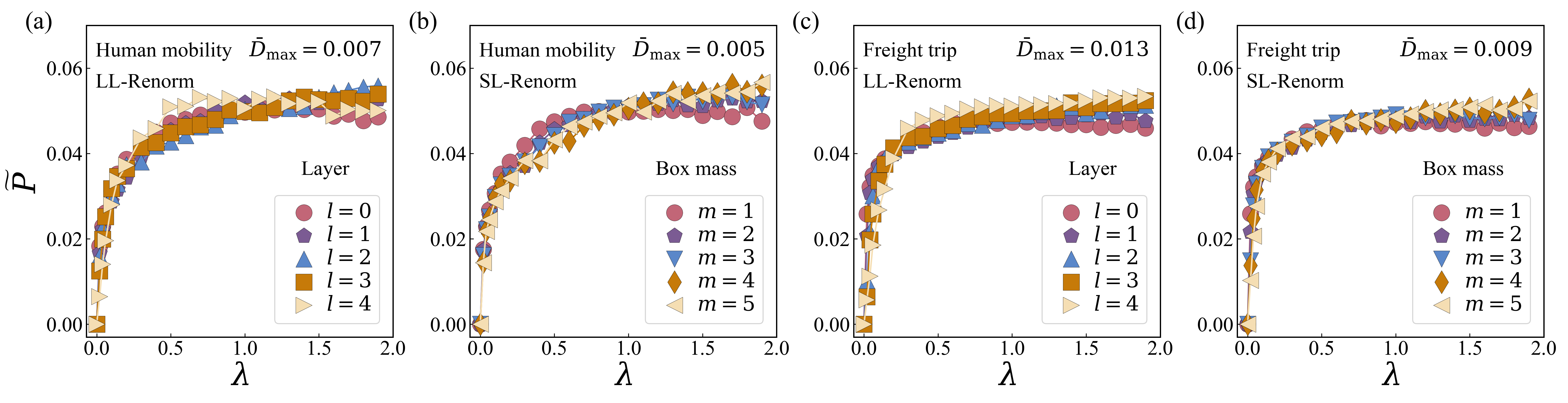
Dynamic process similarity We simulate a weighted susceptible-infected-susceptible (SIS) epidemic spreading model on multi-scale mobility networks. The relationship between infectivity λ and relative infection proportion P̃ remains similar across scales, indicating self-similar epidemic dynamics.
Fig. 4. Epidemic spreading dynamics on multi-scale mobility networks.
05 / Result B
Although NLBC uses only mobility interactions, the resulting renormalized networks exhibit clear spatial cohesion when projected onto geographic maps. At coarser scales, the renormalized groups further align with established political and socioeconomic boundaries, with fourth-layer human mobility groups corresponding to certain provincial boundaries and second-layer freight trip groups corresponding to the core regions of several urban agglomerations.
Fig. 5. Geographic maps of selected LL-Renorm layers for the inter-city human mobility (l=4) and freight trip (l=2) networks. Nodes within the same renormalized node are represented by the same color.
06 / Result C
Using the nested boxes generated by LL-Renorm, we identify a recursive hierarchy of core cities by selecting the highest-strength city within each box. The resulting hierarchies differ between human mobility and freight trip networks, showing that city centrality varies across both mobility systems and spatial scales.
Fig. 6. Hierarchical core-city identification across layers in (a) the inter-city human mobility and (b) freight trip networks. The upper-right schematic illustrates the recursive identification procedure. The number above each city indicates its global node strength rank in the original network.